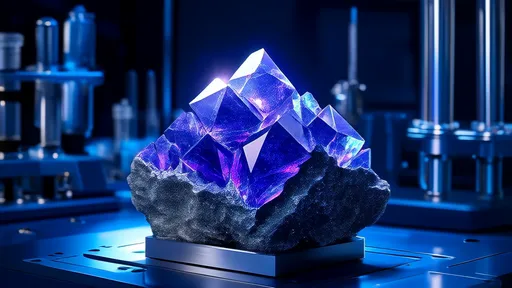
The world of gemstone synthesis has reached a remarkable milestone with recent breakthroughs in laboratory-created cobalt spinel. This dazzling blue material, long prized for its vivid coloration and durability, has traditionally been challenging to produce with the same optical properties as its natural counterpart. However, cutting-edge research from materials science laboratories across Europe and Asia has finally cracked the code, opening new possibilities for both the jewelry industry and technological applications.
For decades, the quest to perfect synthetic cobalt spinel has been the holy grail of crystal growth specialists. Unlike other synthetic gemstones that have been successfully commercialized, cobalt spinel resisted easy replication due to its complex crystal structure and unique color mechanisms. The vibrant blue hue comes from cobalt ions occupying specific lattice sites within the magnesium aluminate structure - a delicate arrangement that proved extraordinarily difficult to recreate in controlled laboratory conditions.
The breakthrough came when researchers at the Swiss Federal Institute of Technology developed a modified flux growth method that allows for precise control over cobalt distribution within the crystal matrix. By carefully regulating temperature gradients and introducing novel mineralizers, the team achieved unprecedented uniformity in color distribution. "What we've accomplished is essentially giving nature a helping hand," explains Dr. Elena Vogt, lead researcher on the project. "We're not just mimicking the natural formation process - we're actually improving upon it in terms of consistency and purity."
Traditional synthetic spinel production often resulted in uneven coloration or cloudy inclusions, limiting its use in high-end jewelry. The new generation of lab-grown cobalt spinel exhibits remarkable clarity and color saturation that rivals - and in some cases surpasses - the finest natural specimens. Gemological laboratories report that these new synthetics show absorption spectra nearly identical to natural cobalt spinel from historic sources like Sri Lanka and Vietnam.
Beyond its aesthetic appeal, synthetic cobalt spinel is attracting attention from unexpected quarters. The material's unique combination of hardness (8 on the Mohs scale), chemical stability, and optical properties make it ideal for specialized industrial applications. Aerospace engineers are particularly interested in its potential as a protective coating for optical sensors, while laser technology developers see promise in its ability to withstand high-energy beams without discoloration or degradation.
The environmental implications of this advancement shouldn't be overlooked. Mining for natural cobalt spinel has always been challenging due to its rarity and the often remote locations of deposits. Laboratory production offers a sustainable alternative that eliminates the ecological damage associated with traditional mining operations. "We can now produce carat quantities of flawless material with minimal energy input and virtually no waste byproducts," notes materials scientist Dr. Rajiv Mehta from the Singapore Institute of Technology.
Market analysts predict that synthetic cobalt spinel will follow a similar trajectory to lab-grown diamonds - initially facing skepticism from traditional jewelers before gaining widespread acceptance. Early adopters in the jewelry industry report strong consumer interest, particularly among younger buyers attracted to both the gemstone's beauty and its ethical production story. Major luxury brands are already experimenting with designs featuring the material, with several high-profile launches expected later this year.
Technological applications may ultimately dwarf jewelry uses in terms of volume. The electronics industry requires precisely engineered materials with consistent properties - something naturally mined gemstones can rarely provide. Synthetic cobalt spinel's ability to be "tuned" during the growth process to emphasize specific characteristics makes it invaluable for advanced optical devices. Researchers at Tokyo University have already demonstrated its effectiveness in high-performance filters for satellite imaging systems.
The synthesis process itself represents a fascinating marriage of ancient knowledge and cutting-edge technology. While the basic principles of crystal growth date back centuries, modern techniques allow for atomic-level control that was unimaginable just a decade ago. Advanced spectroscopy methods enable real-time monitoring of crystal development, while computer modeling helps predict optimal growth conditions before the process even begins. This combination of empirical observation and theoretical understanding has dramatically reduced the trial-and-error period typically associated with new material development.
Looking ahead, researchers are exploring ways to expand the color palette of synthetic spinel while maintaining its desirable physical properties. Early experiments with alternative transition metals have produced striking results, including vivid purples and deep teals. Some visionaries in the field even speculate about "designer gemstones" with customized optical effects that don't exist in nature - materials engineered not just to imitate natural stones, but to surpass them in beauty and functionality.
As with any disruptive technology, the rise of synthetic cobalt spinel raises important questions about gemstone valuation and identification. Gemological institutes worldwide are racing to develop reliable detection methods, though the latest generation of synthetics presents unprecedented challenges. "The line between natural and synthetic is becoming increasingly blurred," admits Dr. Thomas Weiß from the International Gemological Laboratory. "We're entering an era where the distinction may ultimately come down to provenance rather than measurable properties."
The economic implications are equally profound. While high-quality natural cobalt spinel will likely remain valuable due to its rarity, the synthetic version could democratize access to this stunning gemstone. Price projections suggest lab-grown material will sell for a fraction of natural stones, potentially opening new markets in fashion jewelry and accessories. At the same time, some industry observers worry about market confusion and the potential for undisclosed synthetics to undermine consumer trust.
From a scientific perspective, the successful synthesis of cobalt spinel represents more than just a technical achievement - it validates our growing understanding of crystal chemistry and materials engineering. The lessons learned from this project are already being applied to other challenging material systems, accelerating progress across multiple disciplines. What began as an effort to recreate a beautiful gemstone may ultimately contribute to advancements in fields as diverse as quantum computing and medical imaging.
The story of synthetic cobalt spinel continues to unfold, with new developments emerging almost monthly. As production scales up and applications multiply, this laboratory-born material seems poised to make a significant impact both above and below the earth's surface. Whether adorning a piece of fine jewelry or enabling cutting-edge technology, it stands as testament to human ingenuity's ability to harness nature's principles while creating something entirely new.
For gem enthusiasts and materials scientists alike, these are exciting times. The once-elusive cobalt spinel has been captured in laboratory conditions - not as a pale imitation, but as a vibrant new chapter in the story of human material innovation. As synthesis techniques continue to advance, who knows what other gemological marvels await discovery in the crucibles of modern laboratories?

By /Aug 19, 2025

By /Aug 19, 2025
By /Aug 19, 2025

By /Aug 19, 2025

By /Aug 19, 2025

By /Aug 19, 2025

By /Aug 19, 2025
By /Aug 19, 2025

By /Aug 19, 2025

By /Aug 19, 2025
By /Aug 19, 2025
By /Aug 19, 2025

By /Aug 19, 2025

By /Aug 19, 2025

By /Aug 19, 2025

By /Aug 19, 2025

By /Aug 19, 2025
By /Aug 19, 2025

By /Aug 19, 2025

By /Aug 19, 2025
