In the bustling ateliers and design houses where fashion comes to life, there exists a pivotal yet often unsung role that bridges the gap between creative vision and tangible reality: the fashion sample maker. These skilled artisans are the vital link in the transformation of a designer's two-dimensional sketch into a three-dimensional garment, a process that is both an art and a science. Without their expertise, the most breathtaking designs would remain confined to the pages of a sketchbook, never to grace a runway or a retail rack.
The journey begins with the designer's illustration, a representation of an idea, a mood, a statement. But a drawing, no matter how detailed, cannot convey the intricacies of structure, the behavior of fabric, or the nuances of fit. It is the sample maker who interprets these visual cues, translating them into a technical language of patterns, seams, and stitches. They must possess a profound understanding of garment construction, knowing how different materials will drape, stretch, or hold their shape. This requires not only technical proficiency but also a kind of intuitive empathy for the designer's intent, an ability to see the soul of the garment within the lines of the sketch.
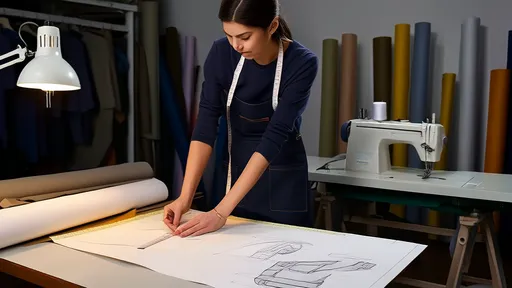
Their workspace is a laboratory of creation, strewn with rolls of fabric, spools of thread, and an array of specialized tools. Using the initial sketch and a set of specifications—often outlined in a tech pack—the sample maker drafts the first pattern. This is a foundational blueprint, a map cut from paper or cardstock that will guide the cutting of the fabric. This stage is critical; a miscalculation in the pattern can lead to a domino effect of fitting issues, rendering the sample unusable. Precision is paramount. They must account for seam allowances, grain lines, and the intended ease of the garment, all while anticipating how the chosen textile will interact with the human form.
Once the pattern is perfected, the meticulous process of cutting and assembling begins. Each piece of fabric is carefully laid out and cut, often by hand for these initial samples to ensure absolute accuracy. Then, under the hum of an industrial sewing machine, the pieces are joined. The sample maker is a master of their machinery, knowing exactly which stitch, tension, and presser foot to use for a sheer silk chiffon versus a rigid denim or a delicate lace. They build the garment from the inside out, constructing the inner architecture—interlinings, boning, pads—that gives a jacket its sharp silhouette or a gown its voluminous skirt. This is where the magic truly happens, where flat shapes evolve into something that can be worn.
The first incarnation of the garment is known as the toile or muslin, typically constructed from a plain, inexpensive cotton calico. This prototype is not about aesthetics; it is a test model for fit and structure. The designer and sample maker conduct a fitting, usually on a live model or a dress form that matches the brand's standard measurements. They scrutinize the hang of the fabric, the balance of the seams, the comfort of the movement. Pieces of tape are applied to mark necessary adjustments—a nip at the waist, a longer sleeve, a adjusted neckline. The sample maker notes every change, for this iterative process of fitting and alteration is the heart of their work. It may take several toiles and multiple fittings to achieve the perfect form.
Only after the toile is approved does work begin on the final sample using the actual intended fabric. This stage introduces a new set of challenges, as the material's unique properties come into play. A luxe wool crepe will behave entirely differently from the simple calico of the toile. The sample maker must now adapt, handling precious materials with utmost care to avoid costly errors. This final sample must be impeccable, as it will serve as the master template for the entire production run. It is the physical standard against which all subsequent garments will be measured, the definitive realization of the design. It will be used for photo shoots, presentations to buyers, and fashion shows, representing the brand's vision to the world.
Beyond mere technical execution, the best sample makers are collaborative partners to the designers. They engage in a continuous dialogue, offering solutions to construction problems and sometimes suggesting alterations that enhance the original design. A designer might envision a dramatic sleeve that seems to defy gravity, and it is the sample maker who engineers the hidden support system to make it possible. This relationship is built on mutual respect and a shared passion for excellence. Their critical eye and problem-solving skills can save a collection from potential disaster, catching flaws that were invisible on paper.
In today's fast-paced fashion industry, the role is evolving but no less critical. While technology like CAD software and 3D prototyping is becoming more integrated, the human touch of the sample maker remains irreplaceable. Software can simulate drape, but it cannot replicate the exact hand-feel of a fabric or the subtle way it moves on a body. The sample maker's empirical knowledge, gained through years of experience, is the essential counterpoint to digital innovation. They ensure that the romance and craftsmanship of fashion are preserved in an increasingly automated world.
Ultimately, the fashion sample maker is an alchemist, transforming abstract ideas into wearable art. They operate in the crucial space between imagination and reality, possessing a rare blend of artistic sensibility and engineering precision. Their work is the silent, steadfast foundation upon which the entire edifice of the fashion industry is built. Every garment that tells a story, that empowers the wearer, that captures a moment in style, does so because a sample maker first mastered the art of making it real.
By /Aug 21, 2025
By /Aug 21, 2025
By /Aug 21, 2025
By /Aug 21, 2025
By /Aug 21, 2025

By /Aug 21, 2025
By /Aug 21, 2025
By /Aug 21, 2025

By /Aug 21, 2025
By /Aug 21, 2025
By /Aug 21, 2025

By /Aug 21, 2025
By /Aug 21, 2025

By /Aug 21, 2025
By /Aug 21, 2025
By /Aug 21, 2025

By /Aug 21, 2025
By /Aug 21, 2025

By /Aug 21, 2025

By /Aug 21, 2025
